
You want an AI assistant that knows your business: your products, your policies, your way of talking to customers. Out of the box, a language model knows none of that. There are two main ways to fix it: RAG and fine-tuning. They solve different problems, and picking the wrong one wastes time and money.
What Is RAG?
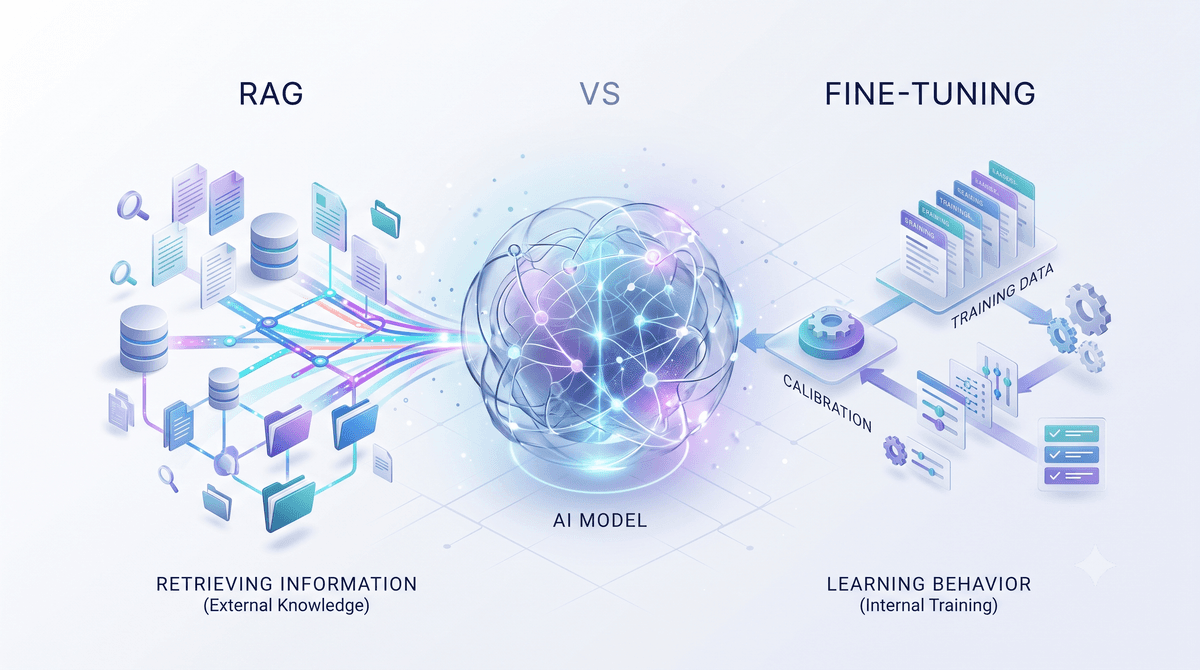
RAG (retrieval-augmented generation) connects a model to your documents. When someone asks a question, the system searches your files first, pulls the most relevant passages, and asks the model to answer using only those passages. The answer can point back to its sources, so people can check it.
Think of it as giving the model an open-book exam. It doesn't memorise your handbook. It looks things up every time.
What Is Fine-Tuning?
Fine-tuning trains a model further on examples you provide. It changes how the model behaves: its tone, its format, the way it handles a specialist task. It doesn't reliably teach the model new facts, and those facts go out of date the moment your documents change.
RAG changes what the model knows. Fine-tuning changes how the model behaves.
When to Choose RAG
- →Your answers live in documents: policies, manuals, contracts, help articles, product specs.
- →Information changes often: prices, stock, procedures. Re-index the documents and the answers update.
- →You need citations: support, legal, finance and HR teams need to see where an answer came from.
- →Different people see different data: RAG can respect document permissions, so staff only get answers from files they're allowed to open.
When to Choose Fine-Tuning
- →You need a consistent voice: product descriptions or emails that always sound like your brand.
- →You need a strict format: structured outputs like JSON, reports or classifications, every time.
- →The task is specialist: medical coding, legal clause tagging, or industry jargon a general model handles poorly.
- →You want speed or lower cost: a smaller fine-tuned model can sometimes replace a larger, slower one.
When to Use Both
Many production systems combine them. A fine-tuned model handles tone and format, while RAG supplies the up-to-date facts. A support assistant, for example, might be tuned to write in your brand voice and use RAG to pull the right refund policy.
- ✓Is the problem missing knowledge? Start with RAG.
- ✓Is the problem inconsistent behaviour? Consider fine-tuning.
- ✓Is it both? Start with RAG and good prompts, then fine-tune once you have real examples of what good looks like.
Start Simple
In most projects we start with RAG and well-structured prompts. It's faster to build, easier to update, and gives you real usage data. Fine-tuning comes later, once you know exactly which behaviour needs improving. If you're not sure which route fits your use case, Devex Hub can review your data and recommend the simplest setup that works.
Want help putting this into practice?
We scope the use case with you, build it on your real data and stay on after launch.
Book a call